AI Headlines vs. Reality: Capability ≠ Impact
Editor's Take
Two AI headlines from this past week caught my eye:
Block (Jack Dorsey) announced it will cut 4,000+ people — nearly half its workforce — framing it as a shift to a "new way" of running the company, with AI enabling smaller, flatter teams. (AP News)
Citrini Research published a provocative scenario piece, "The 2028 Global Intelligence Crisis," modeling what happens if AI keeps exceeding expectations: an "intelligence displacement spiral" where payroll shrinks, consumer demand weakens, and the S&P drops ~38%. Citrini themselves wrote in the second sentence that "what follows is a scenario, not a prediction." (Citrini Research)
Both went viral. Block's stock jumped more than 20%. Citrini's post was widely cited as helping spark a selloff in software and financial stocks. (FA Mag) The narratives fed each other perfectly — one company acting, one analyst imagining the consequences at scale.
I think the directional point is right: AI capability is advancing quickly, and ignoring it would be foolish. But before we jump from headlines to "AI will replace everything imminently," a few things are worth sitting with.
1. AI is powerful — but narrow. It's not superintelligence.
A better mental model comes from Narayanan and Kapoor's AI as Normal Technology (2025): AI is a general-purpose technology — like electricity, like the internet — transformative, but not a separate species that instantly rewrites society. (Knight First Amendment Institute)
Today's AI can do certain narrow things remarkably well. It can generate fluent text, write working code for well-defined problems, summarize documents, and translate languages. In constrained domains with clear inputs and verifiable outputs, it's genuinely impressive.
But step outside those boundaries and the cracks show quickly. Models still struggle with sustained, multi-step reasoning across domains — the kind of work that requires holding context, questioning assumptions, and synthesizing information from different fields without step-by-step guidance. Narayanan and Kapoor call this the "capability-reliability gap": the distance between what a model can do in a demo and what it can do reliably in a messy, real-world workflow. They note this gap has been a "major barrier" to building useful AI agents that automate real-world tasks end-to-end. (Knight First Amendment Institute)
And reliability remains a real constraint. When models are used without proper controls or verification — especially in high-stakes or client-facing contexts — the results can be confidently wrong.
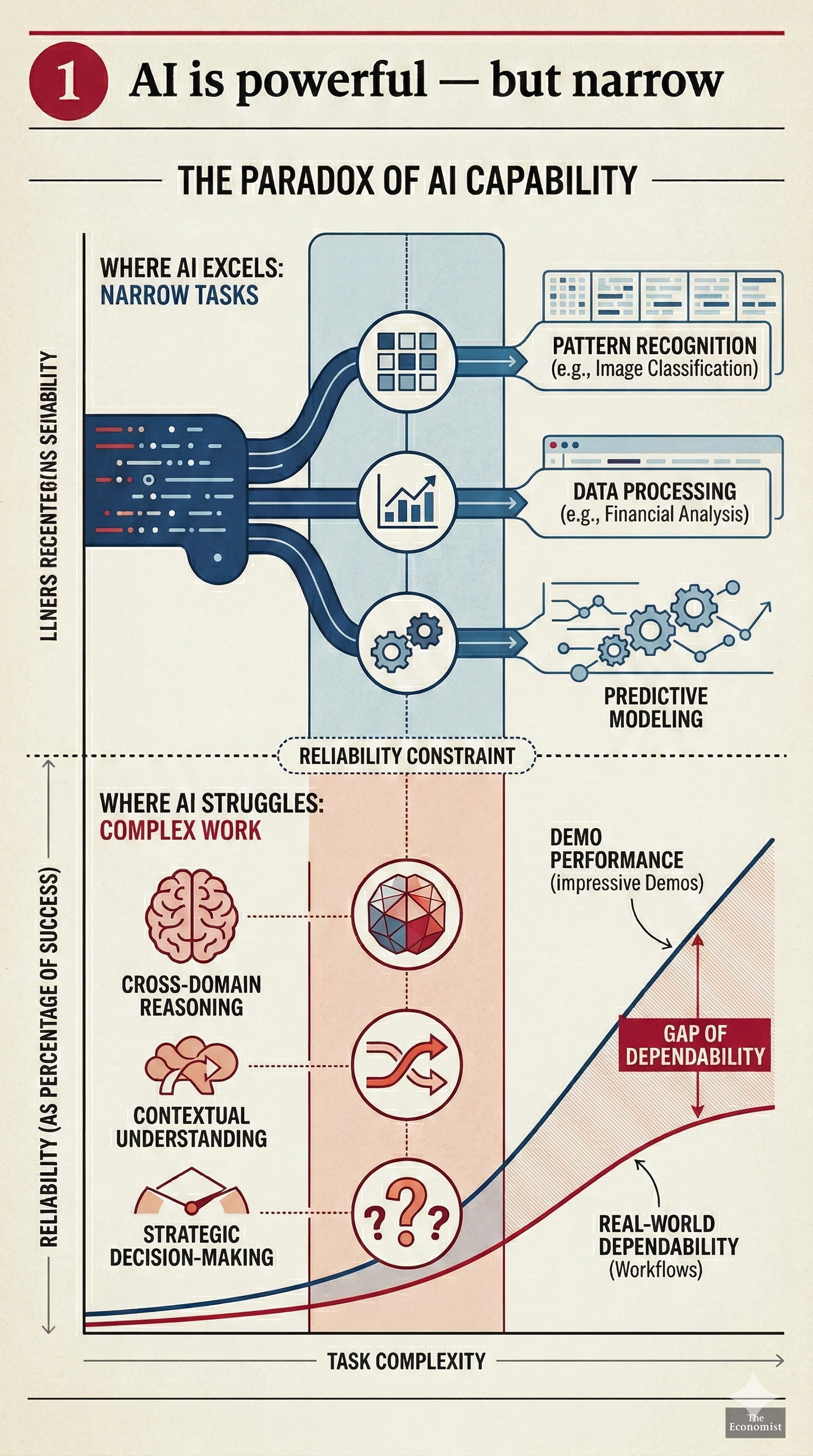
The Paradox of AI Capability — the gap between demo performance and real-world dependability widens with task complexity.
None of this means AI isn't useful — far from it. It means that how you use AI matters enormously. The value comes from pairing AI capability with good workflow design, verification, and human judgment — not from treating it as an autonomous oracle.
Skepticism isn't useful; reform is. It means that if you use it, use it where it matters most — and use it enormously. Value comes from pairing capability with good workflow design, verification, and human judgment — not from treating it as an autonomous muscle or force.
2. Invention ≠ adoption ≠ impact. The gap is where competitive advantage lives.
History doesn't repeat exactly, but the pattern is consistent: general-purpose technologies take time to reshape economies, because the hard part isn't the invention — it's building the complements around it.
Steam. Watt's improved engine entered commercial use in the 1770s. But major transport and industrial reshaping required complements that took generations to build — rail networks (Stockton & Darlington, 1825; Liverpool–Manchester, 1830), capital formation, coal supply chains, and redesigned factory workflows.
Electricity. Edison's Pearl Street Station (1882) was the first permanent commercial central power station — a genuine breakthrough. But the productivity payoff lagged by decades. Early factories simply swapped steam engines for electric motors without redesigning anything — keeping the old layout of a single central power source driving overhead shafts and belts. The real gains only came when factories reorganized around "unit drive" — giving each machine its own electric motor, which allowed completely new floor plans, flexible production lines, and better workflows. Between 1900 and 1930, the share of manufacturing power from electricity grew from about 10% to 80%, but the manufacturing productivity acceleration didn't fully arrive until after World War I — output per labor-hour roughly tripled its growth rate compared to the prior two decades. (ScienceDirect; EH.net) Paul David's classic "Computer and Dynamo" paper (1990) made this the canonical case study for why general-purpose technologies need complements, organizational redesign, and institutional adaptation before they show up in the economic statistics.
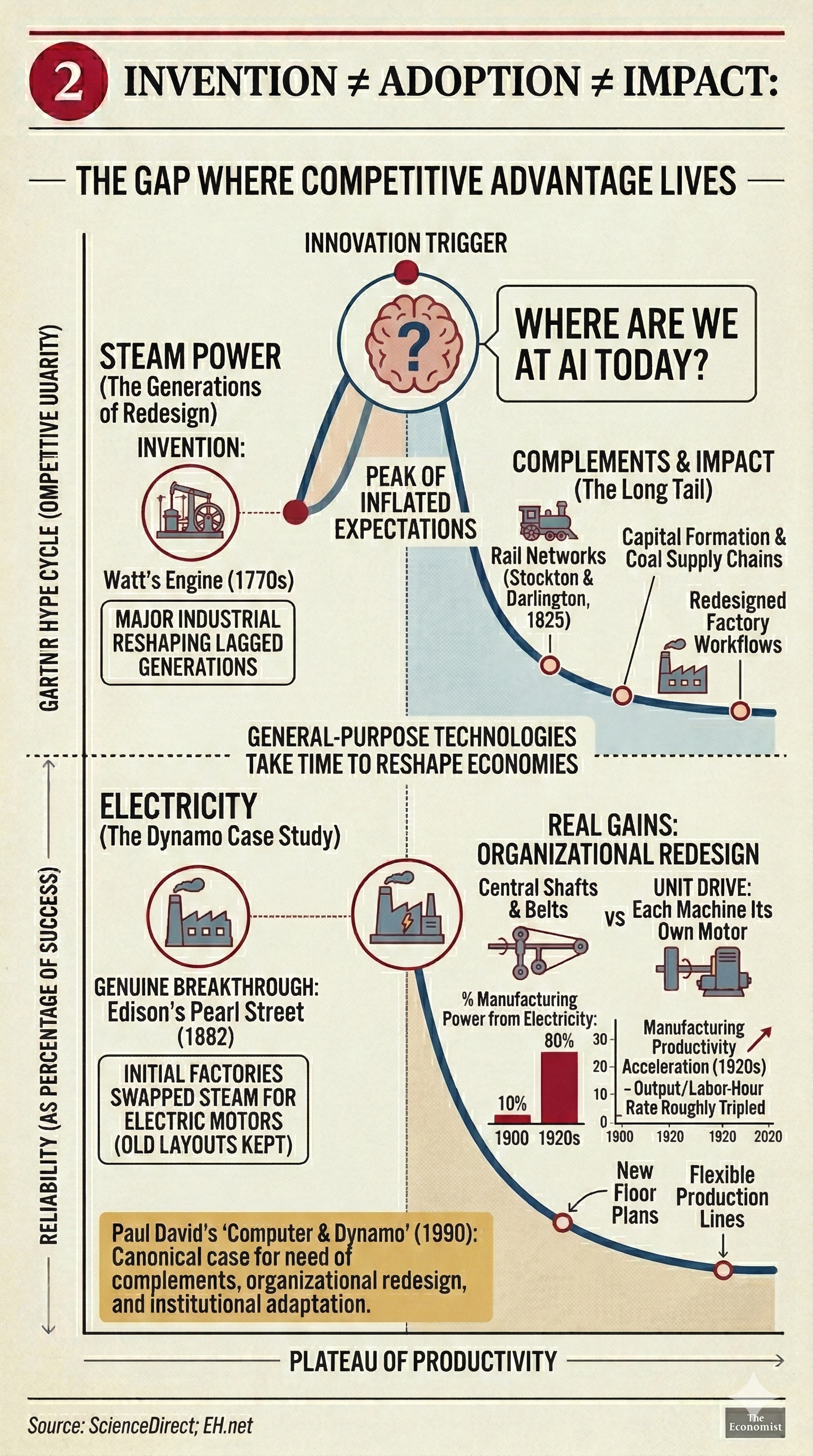
General-purpose technologies take time to reshape economies — the gap between invention and impact is where competitive advantage lives.
The lesson isn't "slow down." It's the opposite. The firms that captured the most value from electricity weren't the ones that waited — they were the ones that redesigned their workflows around the new technology rather than bolting it onto old processes. The same is true for AI. Models are improving fast, but data infrastructure, workflow redesign, controls, and — critically — people learning to work effectively with AI are what turn capability into durable advantage.
This is where we should be leaning in. Narayanan and Kapoor point out that roughly 40% of U.S. adults have used generative AI, but it accounts for only ~0.5–3.5% of actual work hours — most usage is still infrequent and experimental. (Knight First Amendment Institute) That gap between trying a tool and truly integrating it into how you work is exactly where competitive advantage lives. Teams and firms that close that gap faster — that move from experimenting to embedding AI in real workflows with the right controls — will outperform those that don't.
Citadel Securities made a related point with data in their rebuttal to Citrini: AI diffusion is following a historical S-curve, not an exponential one. As their macro strategist Frank Flight put it: "successive waves of technological change have not produced runaway exponential growth, nor have they rendered labor obsolete." What technology has consistently done is reshape how work gets done — and reward the organizations that adapt first. (Citadel Securities; Bloomberg)
3. Follow the incentives behind the narrative.
This isn't cynicism — it's just useful context for interpreting headlines.
On Block: Dorsey framed the cuts as AI-driven, but the backstory matters. Block employed roughly 3,800 people at the end of 2019 and grew to over 12,500 by 2023, according to its filings. Multiple analysts pointed out that these cuts are partly — perhaps largely — unwinding pandemic-era overhiring. Dorsey himself acknowledged on X that he had "incorrectly built 2 separate company structures (Square & Cash App) rather than 1." (Payments Dive) An Oxford Economics report from January 2026 found that many AI-attributed layoffs across the industry are better explained by traditional factors: overhiring, weak demand, and cost-cutting. As they put it: "We suspect some firms are trying to dress up layoffs as a good news story rather than bad news." (Oxford Economics)
On Citrini: Their piece is explicitly scenario-writing — a fictional memo from 2028 — and it generated enormous attention while also drawing strong pushback from market participants and economists. Even the White House chief economist called it "science fiction." But Citrini Research is a paid Substack built around thematic equity investing and macro trading, with a tagline of "you'll never have to ask 'what's the trade?'" Scenario writing is valuable, but it's also attention- and capital-adjacent by design. None of that makes it wrong. But it's worth knowing what you're reading. (Citrini Research; FA Mag)
More broadly: AI narratives tend to benefit capital and vendors — fundraising, valuations, "transformation" budgets — before the real benefits take shape. The incentive to declare a revolution is strong for the people selling picks during a gold rush.
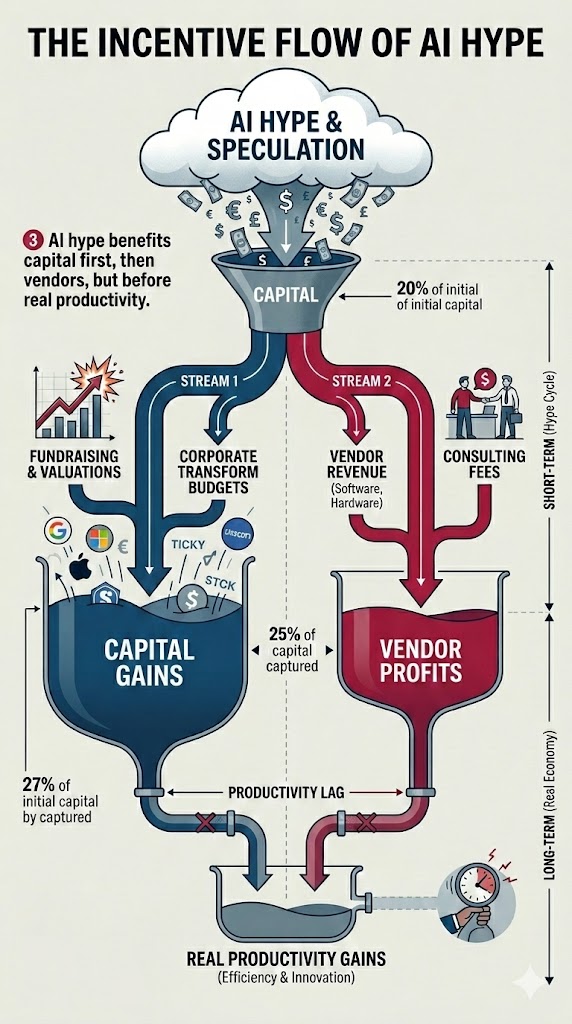
The Incentive Flow of AI Hype — capital and vendors benefit first, real productivity gains lag behind.
Bottom Line
AI is real, and it's getting better. But the gap between capability headlines and economy-wide impact is mostly about complements + adoption + time, not magic. The pattern has repeated across every major general-purpose technology: breakthroughs arrive fast, transformation arrives slow, and the organizations that win are the ones that do the hard work of integration — redesigning workflows, building controls, and developing their people's ability to work with the new tools — rather than waiting for the technology to do it all on its own.
Further reading:
- Narayanan & Kapoor, AI as Normal Technology, Knight First Amendment Institute (April 2025)
- Paul A. David, "Computer and Dynamo: The Modern Productivity Paradox in a Not-Too-Distant Mirror," American Economic Review 80:2 (May 1990)
- Carl Benedikt Frey, The Technology Trap: Capital, Labor, and Power in the Age of Automation (Princeton University Press, 2019)
- Oxford Economics, Evidence of an AI-Driven Shakeup of Job Markets Is Patchy (January 2026)
- Citadel Securities, macro strategy report rebutting Citrini (February 2026); also covered by Bloomberg
- Citrini Research & Alap Shah, The 2028 Global Intelligence Crisis (February 2026)
The views expressed here are my own and do not reflect those of my firm or any affiliated organization. This analysis reflects my current understanding of AI capabilities and limitations, which may change as the technology and market conditions evolve.
Get the newsletter in your inbox
A weekly, curated digest on AI and organizational design.