AI Headlines vs. Reality: Capability ≠ Impact
Two AI headlines from this past week caught my eye:
Block (Jack Dorsey) announced it will cut 4,000+ people — nearly half its workforce — framing it as a shift to a "new way" of running the company, with AI enabling smaller, flatter teams. (AP News)
Citrini Research published a provocative scenario piece, "The 2028 Global Intelligence Crisis," modeling what happens if AI keeps exceeding expectations: an "intelligence displacement spiral" where payroll shrinks, consumer demand weakens, and the S&P drops ~38%. Citrini themselves wrote in the second sentence that "what follows is a scenario, not a prediction." (Citrini Research)
Both went viral. Block's stock jumped more than 20%. Citrini's post was widely cited as helping spark a selloff in software and financial stocks. (FA Mag) The narratives fed each other perfectly — one company acting, one analyst imagining the consequences at scale.
I think the directional point is right: AI capability is advancing quickly, and ignoring it would be foolish. But before we jump from headlines to "AI will replace everything imminently," a few things are worth sitting with.
1. AI is powerful — but narrow. It's not superintelligence.
A better mental model comes from Narayanan and Kapoor's AI as Normal Technology (2025): AI is a general-purpose technology — like electricity, like the internet — transformative, but not a separate species that instantly rewrites society. (Knight First Amendment Institute)
Today's AI can do certain narrow things remarkably well. It can generate fluent text, write working code for well-defined problems, summarize documents, and translate languages. In constrained domains with clear inputs and verifiable outputs, it's genuinely impressive.
But step outside those boundaries and the cracks show quickly. Models still struggle with sustained, multi-step reasoning across domains — the kind of work that requires holding context, questioning assumptions, and synthesizing information from different fields without step-by-step guidance. Narayanan and Kapoor call this the "capability-reliability gap": the distance between what a model can do in a demo and what it can do reliably in a messy, real-world workflow. They note this gap has been a "major barrier" to building useful AI agents that automate real-world tasks end-to-end. (Knight First Amendment Institute)
And reliability remains a real constraint. When models are used without proper controls or verification — especially in high-stakes or client-facing contexts — the results can be confidently wrong.
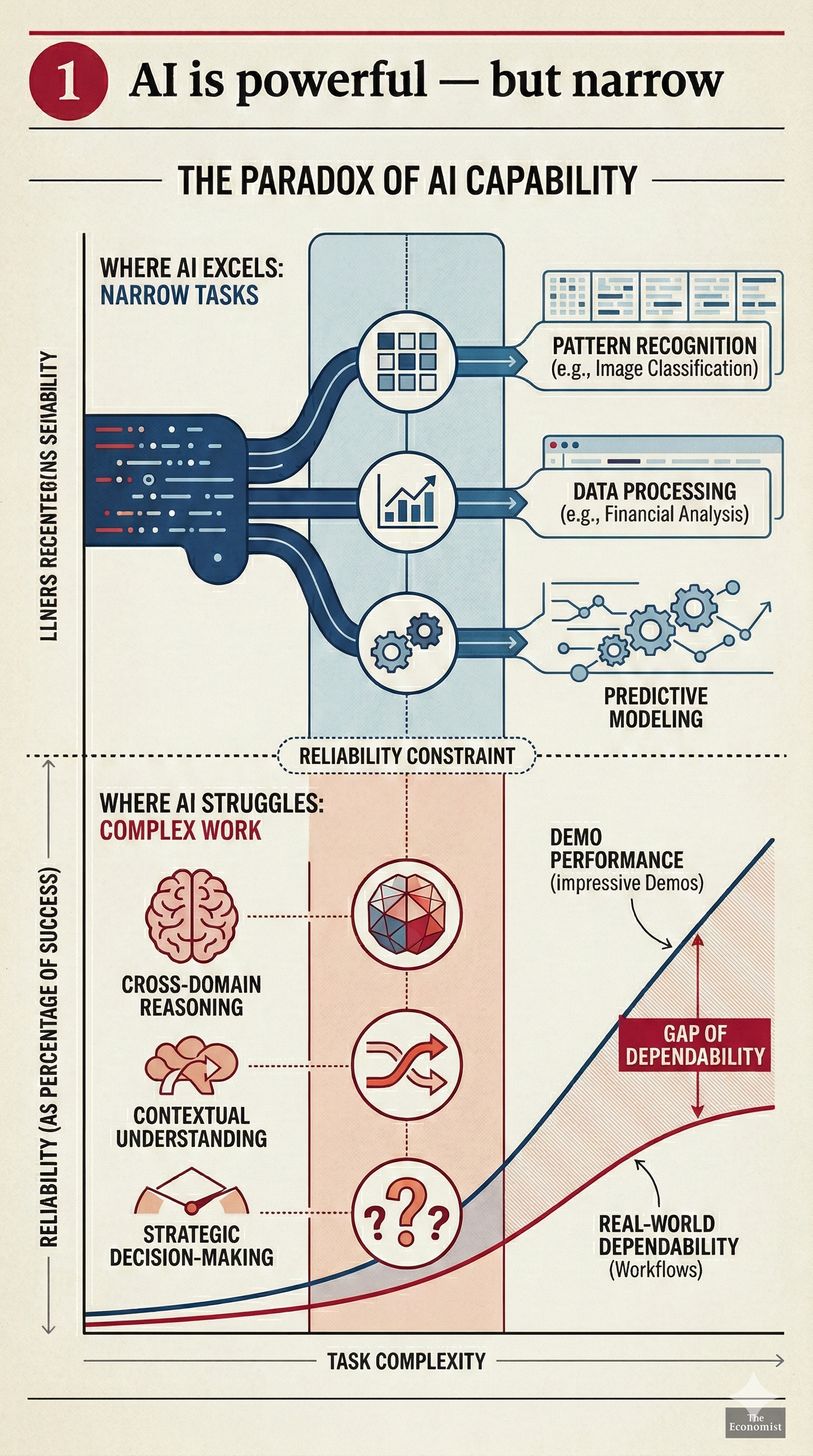
The Paradox of AI Capability — the gap between demo performance and real-world dependability widens with task complexity.
None of this means AI isn't useful — far from it. It means that how you use AI matters enormously. The value comes from pairing AI capability with good workflow design, verification, and human judgment — not from treating it as an autonomous oracle.
Skepticism isn't useful; reform is. It means that if you use it, use it where it matters most — and use it enormously. Value comes from pairing capability with good workflow design, verification, and human judgment — not from treating it as an autonomous muscle or force.
More on AI Trends in the Workplace
- Wealth Management's AI Shift: From Tools to Workflows July 5, 2026
- AI in the Workplace: Five Takeaways From a Closed-Door Conference of the People Building the Evidence May 30, 2026
- AI, Emotion, and Behavioral Coaching April 27, 2026
- Stanford AI Index 2026: AI's Annual Report Card Is In April 20, 2026
Get the newsletter in your inbox
A weekly, curated digest on AI and organizational design.