Special Issue: Anthropic Open-Sources the Wall Street Analyst — and Why You Need to Find Your Katie
AI Brief, Curated
Editor's Take
This week is a special issue. Normally I cover three or four threads in the AI Brief; this week, only one — but in real depth. The reason is that the single most asked-about story in conversations with readers, leaders, and friends across the industry over the last five days has been Anthropic's financial-services agent launch, and the right move is to treat it that way: stop trying to fit it into a "highlights" frame and just go deep.
Anthropic published anthropics/financial-services on May 5 — ten end-to-end agents covering investment banking, equity research, private equity, wealth management, and fund administration, with eleven licensed MCP data connectors (FactSet, S&P, Morningstar, Moody's, PitchBook, LSEG, et al.) wired in. 16,500 stars in five days. The repo does not contain the data — those connectors require licensed seats. What it contains is the workflow: the prompts, the conventions, the modeling templates, the audit checklists, the deck-QC routines, the IC memo structures. For twenty years, this was the closed shop that justified $25,000 Bloomberg terminals and three years of unpaid weekends learning bulge-bracket conventions. Anthropic just made it Apache 2.0. The product story matters; the sociological story matters more.
Below is the deep dive — the design choices that signal where Anthropic thinks the regulated-industry market is going, the open-source pattern that is reshaping vertical AI distribution, and what it implies for the existing professional-services ecosystem. Then in the Org section, a longer essay on the quiet structural constraint that determines whether any of this actually produces measurable productivity inside a financial-services firm: the throughput-literate operator who is, in most firms, two layers below where she needs to be.
This Week's Deep Dive
Anthropic Open-Sources the Wall Street Analyst: Ten Agents, Eleven Connectors, 16.5k Stars
Anthropic / GitHub / Fortune / FISIndustry
The headline number is real and worth sitting with: anthropics/financial-services hit 16,500 stars and 2,100 forks five days after the May 5 launch, with 51 commits, 42 open issues, and 61 open PRs as of this writing. For context, that is roughly the pace of a top-tier developer-tooling launch, in a vertical that has historically been the slowest in technology to embrace open source.
The repo ships ten end-to-end agents — Pitch Agent (comps, precedents, LBO → branded pitch deck), Meeting Prep Agent, Market Researcher, Earnings Reviewer, Model Builder (DCF, LBO, three-statement, comps live in Excel), Valuation Reviewer, GL Reconciler, Month-End Closer, Statement Auditor, and KYC Screener. Each ships two ways from one source: as a Claude Cowork plugin a junior analyst can install on their desktop today, or as a Claude Managed Agent template a platform team can deploy headlessly via /v1/agents. Underneath sits a layer of seven vertical plugin bundles (financial-analysis core, investment-banking, equity-research, private-equity, wealth-management, fund-admin, operations), eleven licensed MCP data connectors (FactSet, S&P Global, Morningstar, Moody's, PitchBook, LSEG, Daloopa, Aiera, Chronograph, MT Newswires, Egnyte), and partner-built plugins from LSEG and S&P Global that ship pre-configured for those data terminals.
What is genuinely surprising is the depth. This is not a marketing repo. The repository contains the actual prompts, the actual skill files, the actual deck-QC routines, the actual Excel-audit conventions, the actual buyer-list construction logic, the actual IC-memo structure. The slash commands read like an analyst's daily checklist — /comps, /dcf, /lbo, /cim, /teaser, /buyer-list, /merger-model, /earnings, /initiate, /morning-note, /sector, /screen, /dd-checklist, /ic-memo, /portfolio, /value-creation, /client-review, /financial-plan, /rebalance, /tlh. For twenty years, this was the closed shop. Excel templates owned by bulge brackets. Bloomberg terminals at $25k a seat. Three years of unpaid weekends learning what the conventions were. Anthropic just published the entire skill ladder under Apache 2.0. The data still requires licensed seats. The workflow does not.
The community response has tracked the repo's depth rather than the announcement's surface. The most-watched YouTube breakdown so far (from the Indie Hacker News channel, May 8) frames it bluntly: "If you build vertical AI in finance, sell SaaS into financial services, work in middle office, or build agentic frameworks — you should be reading this repo like a textbook." On dev.to, a much-shared breakdown calls it "Anthropic's engineered roadmap for making it happen, open-sourced for everyone to study and build on" — emphasis on engineered roadmap, not reference implementation. A solo-CPA practitioner walking through the install reports it took thirty minutes to get the GL Reconciler running against QuickBooks (via a community-built MCP server, not Anthropic's bundled connectors) — which is roughly the speed at which an entry-level analyst tool used to take six months to procure.
A few specific design choices in the repo are worth flagging because they signal where Anthropic thinks the regulated-industry market is going.
"AI drafts, humans sign off" is structural, not a disclaimer. Every agent is explicitly scoped to draft analyst work product staged for review by a qualified professional. None executes transactions, posts to a ledger, binds risk, or approves onboarding. The README is unusually direct about this — "Nothing in this repository constitutes investment, legal, tax, or accounting advice. […] every output is staged for human sign-off." This is the right design for any AI product entering a regulated vertical, and it is also the design that makes adoption legally tractable. The reference architecture is not "agent does the analyst's job." It is "agent prepares the work product; analyst signs the work product." That distinction is what makes deployment in compliance-heavy environments possible at all.
Two surfaces, one source. Every agent ships as both a Cowork plugin (interactive, runs on the analyst's desktop, uses the analyst's credentials) and a Managed Agent template (headless, runs on the Claude Platform, uses managed credential vaults with full audit logs in the Claude Console). Same system prompt, same skill files, same connectors — just different execution wrappers. This is a non-trivial engineering pattern, and it matters because it lets a firm prototype with the plugin and graduate to managed-agent deployment without rewriting anything. Anthropic's Chief Commercial Officer Paul Smith called this the "staircase of autonomy" at the May 5 briefing — capability evolving from research assistance to autonomous senior-analyst-level work, on the same workflow surface.
Eleven licensed connectors is the moat. The repo by itself is workflow. The repo plus FactSet, S&P Global, Morningstar, Moody's, PitchBook, LSEG, Daloopa, Aiera, Chronograph, MT Newswires, and Egnyte is workflow plus the data financial professionals actually use. Anthropic has spent the last six months negotiating MCP integrations with each of these providers, and the companion announcement on May 5 added Dun & Bradstreet, Fiscal AI, Financial Modeling Prep, Guidepoint, IBISWorld, SS&C IntraLinks, Third Bridge, and Verisk to the list, plus a full Moody's MCP app covering 600M+ public and private companies. The model is open. The data plumbing is governed and per-firm-licensed. That is exactly the configuration that gets past a bank's risk committee.
The benchmark Anthropic chose to lead with. The launch claims Claude Opus 4.7 leads Vals AI's Finance Agent benchmark at 64.37%. Note the framing — not MMLU, not HumanEval, not the model-capability benchmarks the lab community argues about. A finance-specific agent benchmark. This is the second indicator (after the JV announcement above) that Anthropic now sells outcomes at the workflow layer, not capability at the model layer.
The strategic question is what the competitive response looks like. The obvious answer is that OpenAI ships an equivalent repo for finance — and probably for healthcare, legal, and at least one other regulated vertical — within two quarters. The open-source pattern is durable enough that whichever lab is first to publish a high-quality reference implementation in a vertical creates the gravitational pull for that vertical's developer community. The less-obvious answer is what happens to the existing professional-services ecosystem. Investment-banking analyst training programs, the second-year-associate workflow at every Big Four firm, the entire market for Excel-template courses — all of these were premised on the conventions that Anthropic just published. They do not become valueless overnight. But the moat shrinks. And the firms that invested most heavily in proprietary workflow IP — bulge-bracket banks, top-tier consultancies — now face a genuine question about whether that IP is still differentiated, or whether it has been quietly commoditized by a public GitHub repo.
One more signal worth flagging. On the same day as the agent launch, FIS — which sits inside roughly 12% of the world's banks — announced a partnership with Anthropic to build a Financial Crime AI Agent for AML investigations. Coinbase has cited the agents in efficiency benchmarks. Citadel quoted Anthropic's launch directly: "Our investment professionals live in data and analytical models, and Claude for Excel meets them there." When the open-source repo, the deep partnership pipeline, and the JV with Goldman, Blackstone, and Hellman & Friedman all land in the same week, the read is unambiguous. Anthropic is not selling a model into financial services. It is becoming the operating layer for it.
Finding Nemo: The Quiet Constraint on AI Transformation in Financial Services
The technology is not the bottleneck. The translator is.
Heads-up: ~2,400 words, roughly a 10-minute read. Builds on the throughput / process-rebuild thread we have been pulling on since Issue #5.
Disclaimer: All opinions in this essay are my own. They do not represent the company's position. This is meant as an academic discussion of organizational change in financial services.
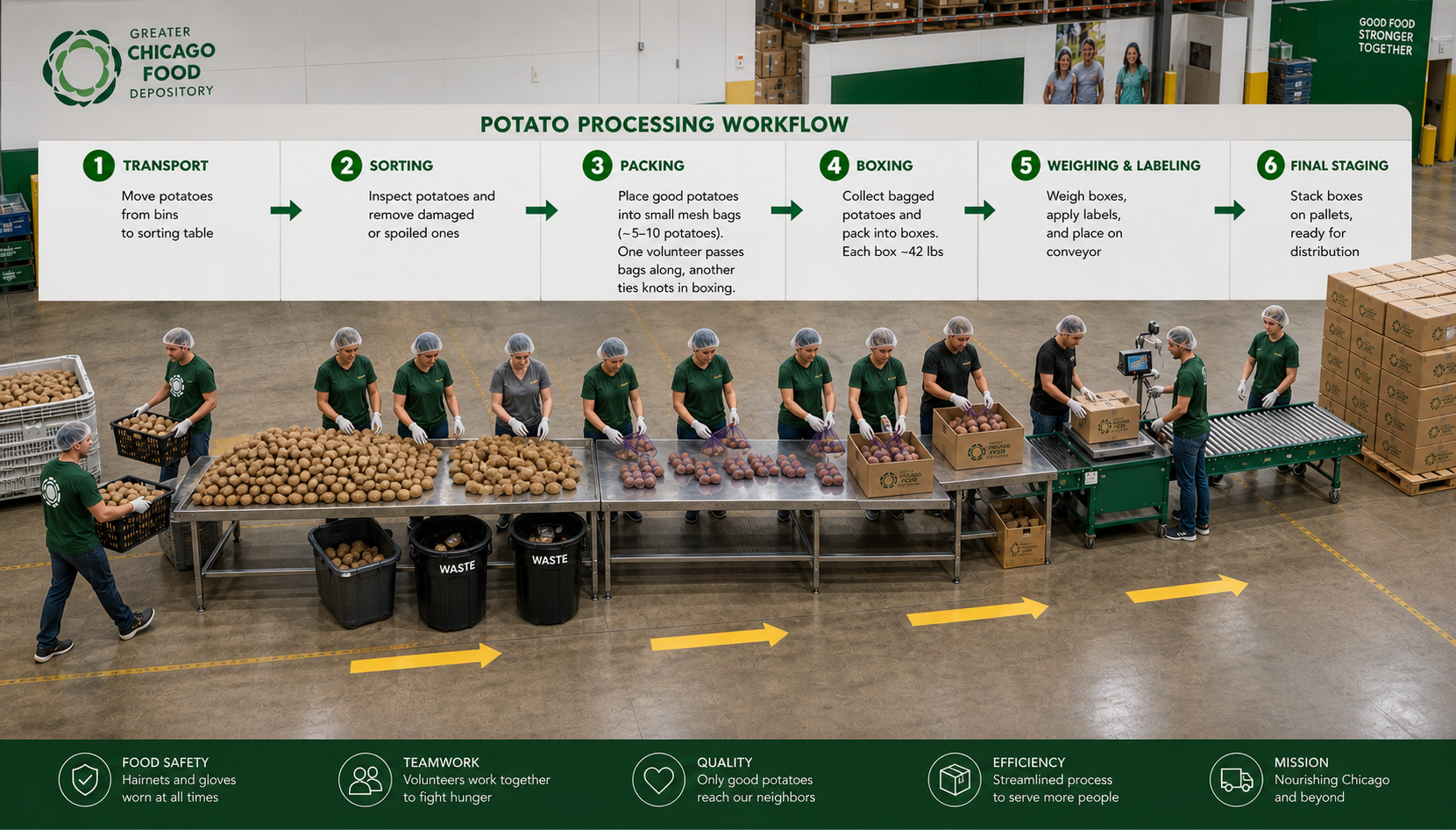
A few weeks ago, more than twenty colleagues from across our firm spent an afternoon at the Greater Chicago Food Depository, sorting and packaging close to 7,000 pounds of potatoes for families facing food insecurity. The depository runs a clean, well-instrumented line: six stations along a stainless-steel table — Transport, Sorting, Packing, Boxing, Weighing and Labeling, Final Staging — feeding a roller conveyor at the end. Every volunteer was assigned a station. Done well, the line moves like a small factory.
The standard flow — six stations, sequential hand-offs, balanced when each station produces and consumes work at roughly the same rate.
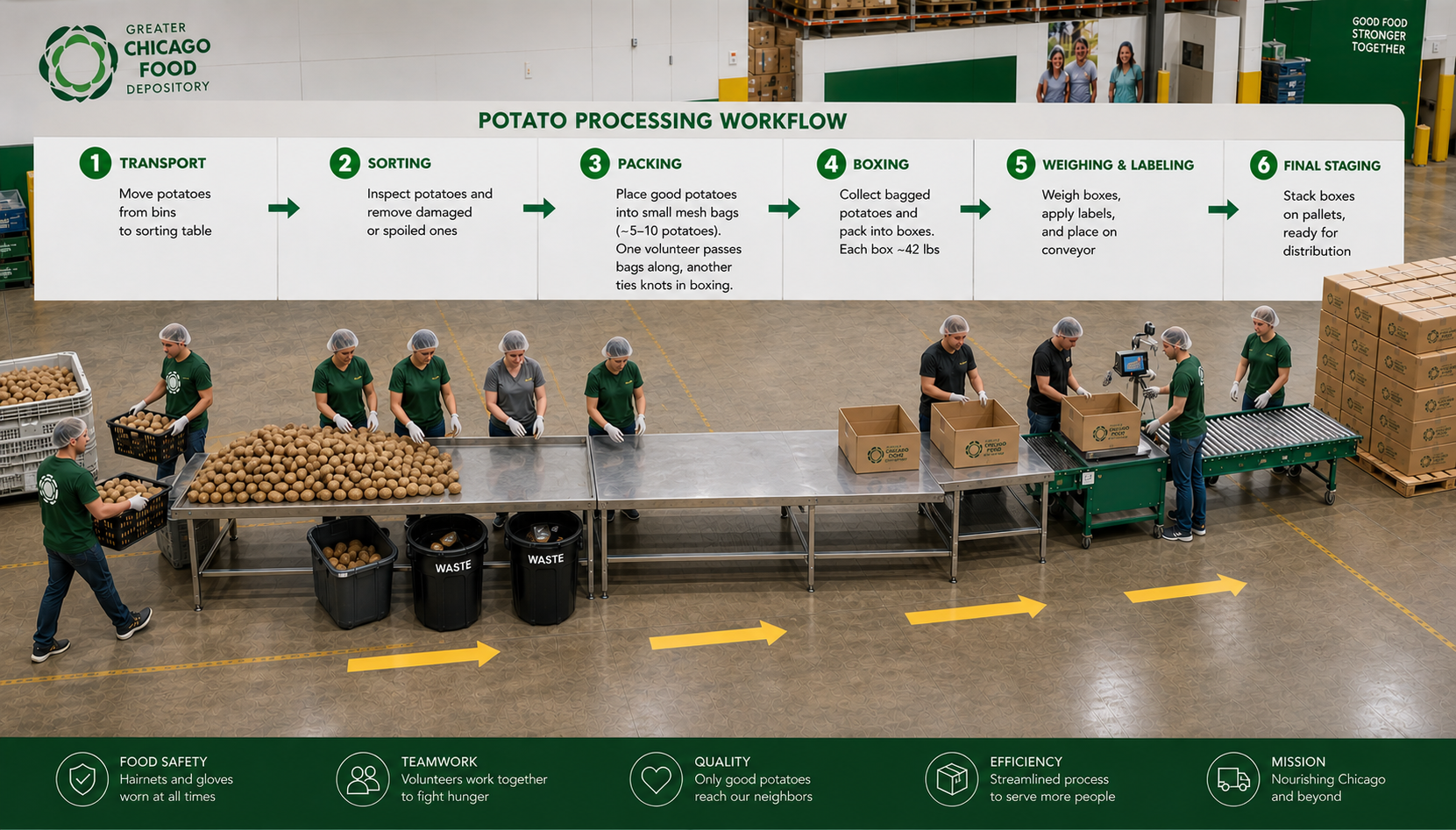
For a while, ours did not. Within ten minutes a mountain of unsorted potatoes had piled up at Sorting. Two volunteers at Boxing stood with empty hands. The Weighing station was idle. Up and down the table, individuals worked hard at the task in front of them, and the line as a whole moved slowly. Most people stayed at their assigned station and waited for work to arrive.
What actually happened — variation in throughput across stations creates a pile-up at one node and idle hands at another. Effort at each station does not solve it.
Except Katie.
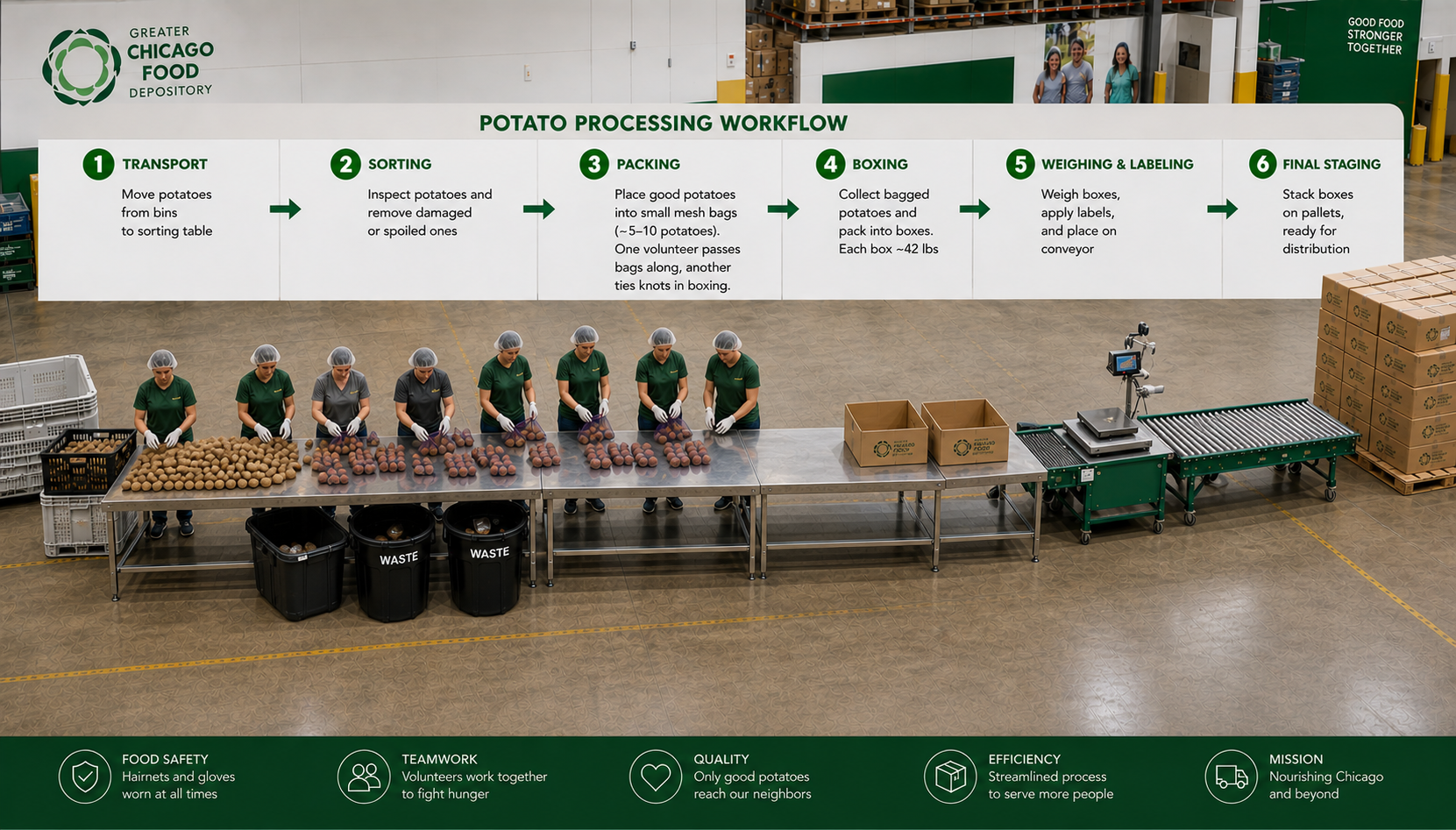
Katie is not the most senior person at our firm. She runs a small team a few layers below top executives. But within a few minutes of the line going slow, she had quietly broken station, walked upstream to Sorting, and started clearing the backlog. She combined Packing and Tying into a single job, because the bag's fill level needs feedback the tier can only give if she's the one filling it. Then she moved upstream and downstream as needed — absorbing variation, never letting any station run hot or cold for long.
The line found its rhythm. We finished the afternoon well.
What Katie actually did — a flexible process design where a roving operator absorbs variation across stations, keeping the line at throughput. The line did not need more effort. It needed someone seeing it as a system.
What I want to write about is not Katie's competence. It is that out of more than twenty smart, capable, motivated professionals — including some of our most senior leaders — only one person had the reflex to look at the line as a system and act on it. The rest of us worked hard at our station. That is a much more interesting observation than it first appears, because it is also the central, mostly unspoken constraint on AI transformation in financial services.
1. Effort is not throughput
Here is the part that should make every executive uneasy: working harder at your station does not produce more boxes of potatoes per hour. It produces a tired person at a station. The line's output is set by the bottleneck and the hand-offs, not by individual effort.
This is exactly what most AI initiatives in financial services run into. The 2024 McKinsey State of AI survey found that more than three-quarters of financial-services firms now use generative AI in at least one function. The MIT NANDA initiative's 2025 State of AI in Business report found that roughly 95% of enterprise generative-AI pilots produce no measurable P&L impact. Two facts that rhyme uncomfortably: nearly everyone is using it; almost no one is getting paid for it.
The reason is the same one we saw at the potato line. An advisor with a generative-AI drafting tool can produce a client email in thirty seconds instead of three minutes — a real, measurable, individual gain. But the firm's quarterly revenue does not move, because the email was never the bottleneck. The bottleneck was somewhere else: in the onboarding hand-off, in the planning cycle, in the data re-entry between three systems, in the approval that exists because of a 2014 exception nobody has revisited. AI sped up a station. The line did not change.
The only way out of this is to redesign the line — and that requires someone with what I have come to call throughput literacy: the reflex to see the system rather than the steps, to ask where work stalls, where information is re-entered, which exceptions are genuinely unique versus normalized, what could be eliminated entirely. It is closer to a habit of mind than a technical skill. And in financial services, it is structurally rarer than it should be.
2. Why the industry is short on Katies
I want to be careful not to overstate this. There are plenty of process-driven people in financial services, and some firms have built deep operational benches. But for most firms, the supply of throughput-literate operators is thinner than the work now demands, and the reason is not mysterious.
The industry's prestige hierarchy was shaped over decades around a different kind of value creation. The highest-status seats belonged to the rainmaker — the advisor with the book, the banker with the relationship, the partner whose name opened doors. Compensation reflected this with rare candor: production-based payouts at the wirehouses, eat-what-you-kill structures at boutique advisory firms, partnership tracks gated on originated revenue. Judgment under uncertainty and the cultivation of trust were the work; everything else was overhead.
For a long time this was a reasonable selection function. The industry's value proposition genuinely was relationships and judgment, and workflows could be allowed to evolve organically — by acquisition, by exception, by the accumulated preferences of senior producers.
But every selection function has a shadow. The people who would have asked "how should this system work?" — the Katies — were sorted into roles the prestige hierarchy quietly discounted. They became operations leaders, business analysts, project managers. They rose, but typically capped two rungs below the producers. In most firms, they did not make partner. The work of designing the line was treated as administrative rather than strategic.
Compare this to industries that built deep operational benches by necessity. Toyota's production system, from its 1950s inception, was premised on the operator-as-systems-thinker (Liker, The Toyota Way, 2004). Semiconductor manufacturing, retail logistics, modern e-commerce — these industries elevated process design to an executive discipline because their economics demanded it. When AI arrived, they had a runway of throughput-literate operators to draw on. Most financial-services firms simply do not have that runway, because the economics of the relationship era did not require building it.
This is a description, not an indictment. It just means that when a CEO asks her team to "drive AI transformation," the request lands in an organization where the people most temperamentally suited to the work are often two layers below where they need to be — and the leaders best positioned to authorize the redesign are, on most days, more like the volunteers standing at their stations than they are like Katie.
3. Hiring the right consulting firm. But they are talking to the wrong people.
Many executives have responded to this challenge by bringing in McKinsey, Bain, BCG, or one of the specialist operations firms. I think that is, in many cases, exactly the right move. These firms have the right mentality, the right methodology, and the right experience for workflow redesign at scale. They are good at the craft. The problem is rarely the firm.
The problem is who they end up talking to.
The default diagnostic engagement — interview the functional leaders, map the as-is process, identify the inefficiencies, design the to-be state — rests on a single load-bearing assumption: that the functional leaders being interviewed are themselves throughput-literate. In financial services, that assumption holds less often than it appears.
I learned this the hard way recently. A senior leader I had worked with for some time spoke about his operation with confidence and fluency. He could describe every step of the workflow in detail, name every system, walk through every exception. For a long time I assumed he was deeply process-driven. Eventually I realized I had mistaken twenty years of repetitive manual execution for systems thinking. He could describe the workflow as it currently ran with extraordinary precision. He had no view at all on how it should run. The two are not the same skill, and from the outside they look identical.
If a consultant had interviewed him as the SME for his function, the resulting workflow map would have been internally coherent, beautifully formatted, and quietly fictional in the most important respect: it would have described the current line as if the current line were the right line. The to-be state designed against it would inherit every assumption embedded in twenty years of habit. The transformation would stall, and everyone involved — the consultants, the leader, the executive sponsor — would correctly diagnose the stall as an "execution issue," because nothing in the process surfaced the possibility that the wrong person had been treated as the source of truth.
This is not a critique of consultants. It is the executive's job, not theirs, to make sure they are pointed at the right people.
4. The good news, and the question
The good news is that in most firms, the Katies are already on the payroll. The selection function pushed them sideways, not out. They are visible by their patterns: they ask why a piece of data is being re-entered into three systems; they build unsanctioned trackers because they cannot tolerate watching a process fail twice; they notice that 80% of "exceptions" follow four patterns; they propose subtraction when everyone else is proposing additions. In a firm of two thousand people, there are typically forty to sixty of them, and most of them sit one or two reporting layers below where they should.
The move that distinguishes the firms that will compound from the firms that will not is for senior leaders, in the age of AI, to take this on personally. Not delegate it. Not outsource it. The work is to identify the Katie in your own function — the person two or three layers down whose process instincts have been quietly carrying the team — and pull them into the redesign as your partner. Sponsor them. Give them air cover. Let them shine in rooms they would not otherwise be in. The reframing is small but consequential: the executive's role in AI transformation is not to be the redesigner. It is to be the sponsor who finds the redesigner and clears the path.
Finding them is not as easy as finding Nemo, and the title is half a joke. They are quiet by temperament. They do not raise their hand. They have spent years adapting to a hierarchy that did not reward what they do best, so they have learned to do it without making noise. You will have to look. You will have to ask different questions in your skip-levels. You will have to notice which of your direct reports are describing the workflow versus which are thinking about how it should run. The two are not the same skill, and from the outside they look identical.
But you will find them. And the moment you sponsor one Katie, augment her with the AI tools and the redesign authority, and let her show what the line can do — that is where the flywheel starts. Other Katies in the firm see it and surface. Other executives see it and start looking in their own functions. The prestige hierarchy that took fifty years to build does not break overnight, but it loosens, in the only way these things ever loosen: one credible example at a time.
Concretely, the sponsorship shows up in a few governance choices. Workflow redesign is named as a leadership discipline, not back-office work. Transformation cells are kept small — five to seven people, not fifteen — because committees cannot redesign workflows. And critically, when outside firms are engaged, the diagnostic interview list is not derived from the org chart alone. The executive sponsor names, in advance and by name, the Katies two and three layers down, and ensures the consultants spend at least as much time with them as with the functional leaders. This sounds like a small contractual detail. It is the single highest-leverage governance change a CEO can make to a transformation engagement.
The McKinsey-grade version of this argument ends with a 2x2 and three numbered recommendations. I would rather end with a question, because a sharper question is more durable than a checklist.
The question I would suggest is not "what AI tools should we deploy?" and not "which firm should we hire to redesign our workflows?" — both are reasonable second-order questions. The first-order question is more personal: "Who is the Katie in my own function, where is she currently sitting, and am I willing to be the executive who pulls her into the room?"
That question is harder to answer than a vendor evaluation. It will surface a few names you have been underweighting, and probably one or two you had not noticed at all. But the firms whose leaders ask it will have a meaningful operating advantage in five years, and the firms whose leaders do not will be running faster note-takers on top of unchanged workflows, wondering why the productivity J-curve has not bent up for them the way Brynjolfsson's research suggested it eventually does.
The dynamo did not transform manufacturing because it was installed. It transformed manufacturing because the people who ran the factory floor were finally allowed to redesign the floor around it. Financial services is at the same juncture, with the same constraint. The technology has arrived. The Katies, in most firms, are already on the payroll.
Find them. Sponsor them. And let them break station.
Sources
Goldratt, E.The Goal: A Process of Ongoing Improvement. North River Press, 1984.
Liker, J.The Toyota Way: 14 Management Principles from the World's Greatest Manufacturer. McGraw-Hill, 2004.